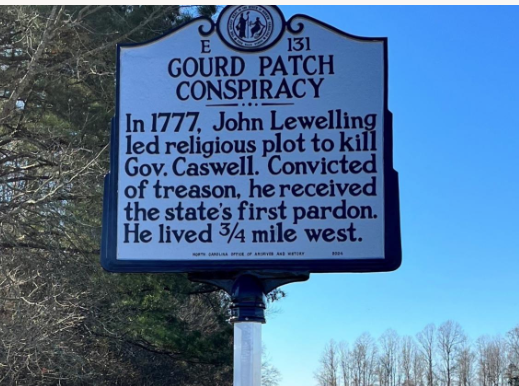
Less than a year after North Carolina adopted its first state constitution, a secret conspiracy threatened the authority of the state’s revolutionary government. In the summer of 1777, John Llewelyn (also called Lewelling*), a well-off plantation owner from Martin County in eastern North Carolina, brought together a like-minded group of men who were dissatisfied with the new political order in North Carolina. They created a plan that included seizing military supplies and attacking prominent Patriot leaders. Their main goal was to challenge the government that had replaced British colonial rule.
Their plot became known as the Llewelyn Conspiracy or the Gourd Patch Affair. Despite their eventual failed efforts, the conspiracy exposed divisions across North Carolina over religion, political loyalty, and the meaning of liberty.
Revolution and Religious Discontent
The American Revolution not only transformed North Carolina’s relationship with Britain, but it also reshaped the state’s political institutions and religious establishment. Under British colonial rule, the Church of England, also known as the Anglican Church, was essentially a state religion that had enjoyed certain privileges, including tax revenue. North Carolina’s Constitution of 1776, however, disestablished the church.
This caused some Anglicans concern about the future of their denomination and its place in public life. Complicating this concern (and fueling it) were rumors of a supposed alliance with Catholic France that might threaten Protestantism more broadly. John Llewelyn became particularly concerned about the threats.
Other concerns with the revolutionary government also led to discontent, such as the demands of the War and resistance to military service. The conspiracy united individuals with different grievances, rather than creating a group motivated by a single political or religious complaint. However, Anglicans were prominent.
The Gourd Patch Plot and Recruitment
By early 1777, Llewelyn, his son William, and James Rawlins, an Anglican lay reader, had helped organize a secret society intended to protect their interests. The group recruited members and developed plans for opposing the revolutionary government. Meetings took place in secretive times and places, including gatherings associated with a pumpkin patch that gave the affair its alternative name.
The conspirators exaggerated their influence to persuade potential members that their cause was gaining momentum. Recruiters claimed that the movement originated in Virginia and spread as far west as the Haw River and south into South Carolina and beyond. In reality, the organization’s reach was far less widespread than they suggested. Although recruiters eventually gathered support in northeastern counties, their network was loosely organized, and surviving evidence does not suggest that they had the broad impact they claimed.
The movement moved beyond religious concerns, as Llewelyn developed a more violent plan to challenge the state directly. According to surviving accounts, he intended to seize the powder magazine at Halifax, capture or kill Governor Richard Caswell, and assassinate prominent Patriot leaders in surrounding counties. He also worked to incite an uprising among enslaved people, in an effort to destabilize the state.
The Conspiracy Exposed
In May 1777, John Clifton of Anson County visited relatives in the region and was introduced to Rawlins. After being sworn to secrecy, Clifton was told about the conspiracy and their proposed alternative constitution and was subsequently given a copy to use in recruiting others. He later claimed to have burned the copy without taking further action. When he returned to the region in July, however, he disclosed to Patriot authorities all that he knew.
In June 1777, officials apprehended William Tyler. Reports circulated that he possessed the organization’s membership list and secret constitution. This threatened to expose the conspiracy’s leadership and network of supporters, which placed Llewelyn and his associates in an exposed position.
The conspiracy collapsed in July. Approximately thirty armed conspirators gathered at Tarboro and attempted to seize the town’s military supplies. Lieutenant Colonel Henry Irwin and local forces defeated the effort in a short time, arresting the men.
Many of those arrested cooperated with investigators, possibly hoping that their testimony would reduce their punishment. These statements became the primary surviving evidence to reconstruct the affair. The government ultimately treated most of those implicated with relative leniency.
First Recipient of Executive Clemency in North Carolina:
North Carolina’s legal system was put to the test with Llewelyn’s arrest and trial. In September of 1777, he was convicted of high treason and sentenced to death. Most of the others accused escaped comparable punishment, reflecting the authorities’ distinction between Llewelyn’s leadership.
Almost immediately, friends, relatives, and other prominent individuals appealed for mercy. Among some of those seeking clemency for Llewelyn were the very people who had been intended targets for his conspiracy. Their appeals raised the question: should a man convicted of plotting against the state be executed, or should the government demonstrate stability through its restraint.
Governor Richard Caswell faced an additional constitutional question. North Carolina’s new government established a separation of legislative, executive, and judicial institutions, but the extent of the governor’s authority to pardon a convicted traitor remained uncertain.
Caswell ultimately granted Llewelyn a pardon, making him the first recipient of executive clemency in North Carolina. The original pardon has not survived, but the historical record shows that Llewelyn was spared execution. He subsequently returned to private life and died in 1794.
* Other spellings include Llewellyn, Lewelling, and Lewellen, but historians today usually write it as Llewelyn.
Region
Timeline
Subject
Sources
Crow, Jeffrey J. “Tory Plots and Anglican Loyalty: The Llewelyn Conspiracy of 1777.” North Carolina Historical Review 55, no. 1 (January 1978): 1–17, https://www.jstor.org/stable/23535379.
Morgan, Jim. “The Gourd Patch Affair.” American Revolution Tour of North Carolina, https://amrevnc.com/gourd-patch-affair/.
Norris, David A. and Carole W. Troxler, “Llewelyn Conspiracy.” NCpedia. 2006; revised September 2023. https://www.ncpedia.org/llewelyn-conspiracy.
North Carolina Department of Natural and Cultural Resources. “Gourd Patch Conspiracy to Be Featured on N.C. Highway Historical Marker.” January 7, 2025, https://www.dncr.nc.gov/news/press-releases/2025/01/07/gourd-patch-conspiracy-be-featured-nc-highway-historical-marker.