Edenton long served as the primary trading center in northeastern North Carolina. Founded in 1712, Edenton was one of the first towns in North Carolina, and between 1722 and 1746 Edenton served as the seat of the colonial government. Edenton’s location on the Albemarle Sound made it a primary stopping point for New England merchants heading to the West Indies and an important destination for shipbuilding materials.
Between 1771 and 1776, 827 ships passed through Edenton and local farmers and merchants exported nearly ten million staves (wood strips used in barrel making), more than sixteen million shingles, 320,000 bushels of corn, 100,000 barrels of tar, 24,000 barrels of fish, 6,000 hogsheads of tobacco, and about one thousand deer skins. During this period, Edenton imported 250,000 gallons of rum, 100,000 gallons of molasses, 600,000 pounds of sugar, 150,000 pounds of salt, and 400,000 yards of linen.
During the American Revolution, Edenton served as a hub of revolutionary activity as its merchants rebelled against English taxation. Prominent Edentonians, like Joseph Hewes, Samuel Johnston, and James Iredell, shaped North Carolina’s revolutionary policy, and the town was important in supplying George Washington’s army. Edenton’s location behind North Carolina’s Outer Banks also largely protected it from major English retaliation.
Following the Revolutionary War, Edenton flourished as a trading port. However, during the early 1800s the tides turned on Edenton’s trade industry. Edenton’s decline was caused by a combination of natural and human factors. First was the change in North Carolina’s Outer Banks. North Carolina’s Outer Banks create a natural land barrier between the Atlantic Ocean and Edenton. Water flow in the Outer Banks caused inlets to open and close. During the late eighteenth and early nineteenth centuries many inlets used to access Edenton closed. Hurricanes and other natural forces closed the Nag’s Head Inlet, the Roanoke Inlet (1795, 1811), and the Currituck Inlet (1828). This limited access to the Albemarle Sound and Edenton, and trade shifted to coastal ports with easier access.
The second major factor was the War of 1812. Prior to the War of 1812, Thomas Jefferson’s administration enacted the Nonimportation Act in 1806 and the Embargo Act in 1807. These acts established an embargo on the importation of French and English goods because those countries refused to recognize American sovereignty and neutrality. During this period, French and English privateers captured American merchant ships, confiscated the goods, and impressed the American sailors. As a result, Edenton’s international trade was greatly limited, and after the declaration of war, the English Navy blockaded the American coast.
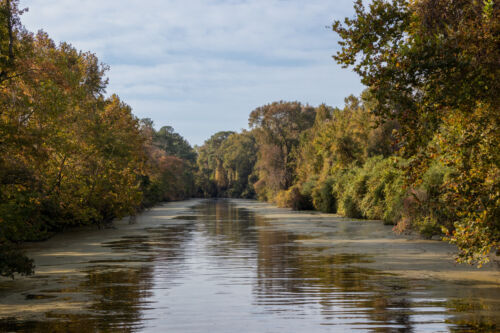
The third major factor was the creation of the Dismal Swamp Canal. A detailed history of the canal is provided by Alexander Crosby Brown’s book The Dismal Swamp Canal. Created with the intention to expanding trade and access in North Carolina, the Dismal Swamp Canal connected the Albemarle Sound to the Chesapeake Bay. Originally opened in 1805, the canal was little more than a muddy ditch only able to support the passage of flatboats. However, by the mid 1820s the Dismal Swamp Canal was widened and capable of reliably supporting commercial traffic. The negative effect on Edenton’s economy was an unforeseen consequence. The canal increased access to North Carolina, but also shifted trade from Edenton to Norfolk, Virginia. Norfolk’s position in the Chesapeake Bay made it easier to access and provided traders with a reliable deepwater port. With the Albemarle Sound accessible through the Dismal Swamp Canal, merchants no longer had to navigate through the treacherous and shallow inlets of North Carolina’s Outer Banks.
Amidst the changes, Edenton stayed a prosperous port until the 1830s. Following the War of 1812 and the Embargo Act in 1807, Edenton bounced back and reclaimed its glory. However the closing inlets in the Outer Banks and the expansion of the Dismal Swamp Canal had lasting effects on Edenton’s shipping economy, and Edenton was no longer the primary destination for trade in northeastern North Carolina.
Even though Edenton’s role as a primary eastern port declined, Edenton’s economy survived through diversification. As trade declined, Edenton’s economy shifted and the town’s fishing industry increased between 1810 and 1850. Following the economic depression caused by the Civil War, Edenton once again achieved prosperity through its fishing, lumbering, and agricultural industries.
More information about early Edenton can be found in Thomas C. Parramore’s Cradle of the Colony: The History of Chowan County and Edenton, North Carolina and in Warren Boeschenstein’s Historic American Towns along the Atlantic Coast.